February 4, 2026
5 min read
We All Hate Being Lost
I was twelve years old, deep in the woods at a local forest preserve, when I realized we were completely lost.
What started as an adventure wandering into the woods with my cousins during a family BBQ turned into something else entirely. When we looked back, the pavilion we thought was behind us was nowhere to be found. We thought we had been going straight, but we had drifted. We turned around, trying to retrace our steps, but every tree looked the same.
That’s when the worry set in. Not a dramatic kind, but the quiet, disorienting kind where you keep walking but have no idea if you’re going the right direction. We needed someone who knew the way. Someone who could point us back and say with confidence: “This way.”
Eventually, our parents came in and found us, and we walked back to our BBQ, but I’ll never forget that feeling. The helplessness of not knowing which direction to go.
Here’s what I’ve learned: Families feel the same way when no one’s providing direction.
Not because they’re in crisis. But because everyone’s moving and no one’s quite sure if they’re headed somewhere meaningful or just... wandering.
In this issue:
Why your family needs you to point them somewhere (and what happens when you don’t)
The research on families who track their direction versus those who drift
How to become the guide your family needs
Read time: 5 minutes
Why Direction Matters
Being lost isn’t just uncomfortable, it’s disorienting. You can’t make decisions when you don’t know where you’re trying to go. Every choice feels arbitrary and every path looks the same.
Most families are wandering without realizing it.
Not because parents don’t care, but because somewhere between managing practice schedules, packing lunches, and making sure everyone gets to bed on time, the bigger question gets lost: Where is this family actually going?
Ask most parents what they want for their kids, and you’ll get answers grounded in important values. “I want them to be kind.” “I want them to work hard.” “I want them to love learning.”
But ask them what their kids are actively doing to grow those values, what the family is building toward together, and the answer gets less clear. You will probably hear vague hopes, good intentions, but no clear destination.
The good news is, you don’t need some elaborate master plan. You don’t need to set direction perfectly. You just need to do it, imperfectly but consistently, so your family doesn’t drift aimlessly.
The Moment I Realized My Family Was Lost
Going somewhere means making forward progress. It doesn’t just happen; it takes effort and intention. After multiple years of family life, I realize we had a calendar, we had routines, and we knew where everyone needed to be each day. But we had no shared direction. No destination we were moving toward together. We were just... managing. Coordinating. Surviving.
Nobody was steering the ship.
This realization brought my mind back to when I was in the middle of those woods at the forest preserve. How disorienting it felt to keep moving without knowing if we were going the right way. How desperately we needed someone who could point us in the right direction.
My family needed the same thing. They needed me to point them somewhere.
Not perfectly. Not with some elaborate master plan. But with clarity
I’m not saying I’ve figured it all out I’m still figuring it out. Some weeks we’re dialed in. Other weeks I realize on Friday that I haven’t thought about our family direction since Monday. I’m not doing this perfectly. But I’m trying to do it consistently.
What the Research Says About Directing Your Family
Here’s what I discovered when I started digging into the research on goal-setting and families:
The families who thrive don’t just have goals. They direct and track.
A study by psychologist Gail Matthews at Dominican University found something remarkable. She divided participants into five groups with different approaches to goal-setting:
Group 1: Thought about goals but didn’t write them down
Group 2: Wrote goals down
Group 3: Wrote goals and action steps
Group 4: Wrote goals, action steps, and shared them with a friend
Group 5: Wrote goals, shared them, and provided weekly progress updates
The results?
Group 5—those who wrote goals, shared them, and tracked weekly progress achieved 76% of their goals successfully.
Group 1, those who just thought about goals, only achieved 43% of their goals.
That’s a 33-point difference. That’s the gap between drifting and directing.
The study wasn’t just about individuals. It was about accountability and tracking. And the principle applies just as powerfully to families. When you determine direction and track it together, that’s when you see real progress.
The results of this study show us two things all families need: a worthy destination and consistent proof you’re moving toward it.
How to Start Directing Your Family
Here’s what I’ve learned (and continue to re-learn) about being a guide for my family:
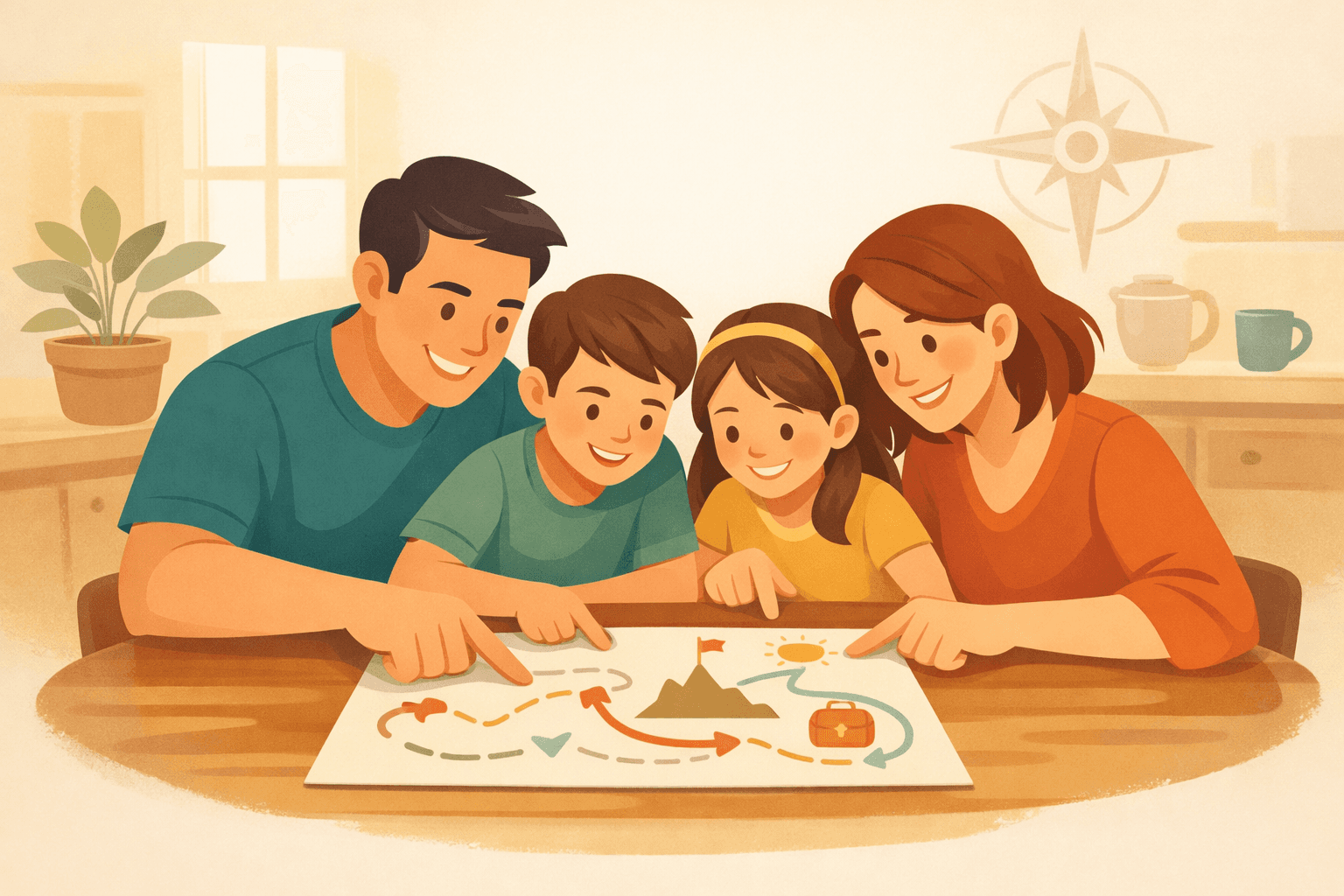
First: Determine direction
You can’t point your family somewhere if you don’t know where you’re going. This doesn’t require a five-year strategic plan. It requires answering one question:
“What do we want our family to be working toward together over the next three months?”
Not individually. Together. What’s the shared destination?
For us, one thing was: “We want to build meaningful friendships in the city we recently moved to.”
That became our direction. That’s what we were building toward.
Second: Make it visible
The study showed that 76% of people who share their goals with someone accomplished them, compared to only 43% who keep goals to themselves.
Sharing once isn’t enough. Goals need to stay visible.
We put our family direction on the fridge. Not hidden in a notebook. Not stored in my head. Visible. Where everyone walks by it multiple times a day.
This is what I call Clarity, the first principle of family alignment. Not just “we have goals somewhere” but “everyone in this house knows what we’re building.”
Your kids need to see where you’re pointing them. Not just hear about it once in January.
Third: Track progress together
Here’s where most families lose it. They set goals in January. By February, nobody remembers them.
The research is clear: People who set time-bound goals and report weekly progress are 40% more successful than those who write goals but never track them.
We added one question to our weekly family check-in: “What’s one thing you did this week that moved us toward our family goal?”
Some weeks the answer is small, but here’s what happened: we started asking eachother how our goals were going. We see eachother track them. We know we are pursuing something.
This is Commitment—showing your family that the direction you chose isn’t just talk. It’s real, it’s trackable, and it’s happening.
Fourth: Course-correct without shame
“Greatness does not consist of not making mistakes, but in what we do with them.” -John Lawrence
Most weeks, we’re not off track because of some crisis. We’re off track because life happened, and we forgot to check the map.
That’s why weekly check-ins matter. Not because you’re failing. Because you’re leading. You’re saying: “Let’s make sure we’re still heading where we said we wanted to go.”
This is Connection—staying together on the journey, not just arriving at the destination.
And when you notice you’ve drifted? You don’t shame yourself. You just point back to the path. “Hey, we said we wanted to support each other’s goals. Let’s get back to that.”
Fifth: Celebrate the pursuit, not just the arrival
When you celebrate progress, and your family meetings include “What are you proud you kept going with this week?”, you’re not just tracking tasks.
You’re building character that lasts.
This is Celebration—making long-term family investments feel meaningful now, not decades from now when your kids are grown.
My daughter doesn’t just see me finish things. She sees me struggle. She sees me show up on the hard days. She sees me track progress even when it’s slow.
And she’s learning that having direction doesn’t mean you never get lost. It means you have someone pointing you back to the path when you do.
Your Family Is Waiting for You to Point Them Home
I think about those woods sometimes. How lost we felt. How desperately we needed someone who knew the way.
Your family feels the same way when nobody’s providing direction.
Because without someone determining where the family is going and tracking whether you’re getting there, everyone just keeps moving without knowing if they’re headed somewhere meaningful.
Here’s what I want you to know: You don’t need to have it all figured out. You don’t need some elaborate master plan.
You just need to point.
Determine direction. Make it visible. Track it together. Course-correct when you drift. Celebrate the pursuit.
That’s it. That’s how you stop wandering and start leading.
And when your family asks you where your family is going this year, you’ll have an answer. Not a perfect one. But a real one.
Because you decided to be the guide your family needs.
Start This Weekend
Here’s one simple thing you can do this Sunday:
Gather your family. Ask them: “What’s one thing we want to be working toward together over the next three months?”
Write it down. Put it on the fridge.
Then next Sunday, ask: “What’s one thing we did this week that moved us toward that goal?”
That’s it. You’ve started directing. You’ve started tracking.
And that’s how wandering families become families with direction.
Align Your Family
Build a family your kids will want to replicate
Navigation
Stay Connected
© 2026 Align Your Family. All rights reserved.
Privacy Policy
Terms of Service